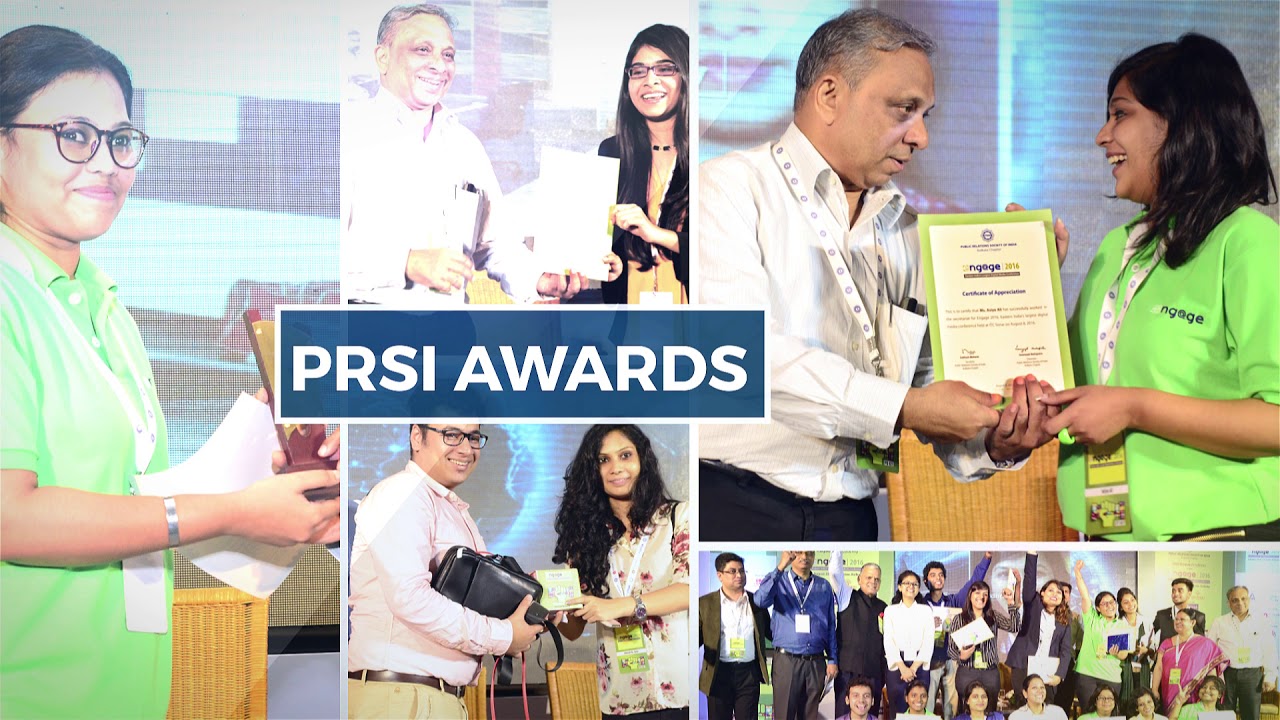
The Public Relations Society of India (PRSI) is the national association of public relations practitioners and communication specialists in India. It functions primarily for professional development. It seeks to formulate and interpret the objectives and potential of public relations as a socially useful function and uphold its value as an integral part of management. It also maintains close links with the academic bodies for promotion of public relations as a subject of management studies.
PRSI came into being as an informal body in 1958 with its headquarters in Mumbai. The genesis of the Society in kolkata can be traced to 1965 when Sanest Lahiri, Shanker Mitres, R. P. Gupta, Prasanta Sanyal, J. M. Kaul and other pioneers of the profession formed a nucleus, known as the Public Relations Circle. However, this was formally merged with the national body in 1968 to strengthen the public relations movement on an all-India basis.
The National Council, the apex body of the PRSI, annually organizes All India Public Relations Conferences to highlight its contemporary relevance. It has a quarterly journal 'Public Relations' which seeks to promote the cause of public relations by bringing to its readers news and articles on public relations in India and abroad. The Society has 30 chapters spread all over the country. Members of the Society, numbering over 3000 are drawn from the private sector and public sector corporations as well as from the government, non-profit organizations and academic bodies.


"Public Relations is negotiating change with minimum of friction
"
                      Sanat Lahiri
 

Promotion of professionalism has been high on the agenda of the Kolkata chapter right from its inception. To provide an academic foundation to the profession, it has brought out a number of ¬monographs on various subjects in the field of public relations and communication by distinguished practitioners.
The Chapter has instituted an annual in memory of lecture Sanat Lahiri, a pioneer of paid relations in India. Over the years, distinguished speakers like Mr. Subhas Ghosal. Prof. A.M Khusro, Mr. Russi Mody, Mr. Chidanan Dasgupta, Prof. Nisith Ranjan Roy. Dr. Asok Mitra, Mr. H. K. Dua, Dr. Nitish Kuma Sengupta Dr. Bikram Sarkar, Dr. Upen Biswas. Dr. Sujit Basu Mr. Biswadip Gupta and Dr. C. V Narasirnha Reddi have delivered these memorial orations on various topics relating to public relations and commnucation.
Kolkata has hosted, so far, five All India Conferences. While Ms. Nandini Satpath, the then Minister for Information and Broadcasting inaugurated the Conference in 1972. Mr. Jyoti Basu, Chief Minister, West Bengal, inaugurated the subsequent Conferences in 1980 and 1989 and the Asia Pacific Conference was inaugurated by Mr. Buddhadeb Bhattacharjee in 1998. The Chapter had invited during 1993-94, a delegation from the Bangladesh Public Relations Association for a professional exchange visit programme to pave the way for a public relations form among the SAARC countries. In 2004, the chapter organized the National Conference in Kolkata which was inaugurated by the Mayor of Kolkata. Mr. Subrata Mukherjee and the valedicton session was granced by the Chief Minister of West Bengal, Mr. Buddhadeb Bhattacharjee.
Apart from holding seminars, workshops and short-term training courses, the Chapter donates books on public relations and allied subjects every year to the Calcutta University, Jadavpur UniN ersity, Bharatiya Vidya Bhavan and George Telegraph Training Institute to encourage study and research of public relations in academic Institutions. Students securing highest marks in public relations in the final examinations of these institutions are also felicitated by the Chapter even year. The Chapter has been participating in the Kolkata Book Fair since 1993. In 1994 an annual memorial lecture in Bengali was instituted in honour of Late Samar Basu, a veteran of the profession. Our Chapter has instituted a new lecture series in memory of Dr. Sarojit Datta who was closely associated with the Chapter till recentl}. Amitava Choudhury, Dipesh Ch. Bhow mik, Pabitra Sarkar. Pranabesh Sen, Ashok Dasgupta. Dibyendu Palit and Sovan Som, P. K. Dutt. Indrani Sen delivered this memorial oration on various topics relating to PR & Journalism.

In 1968, the First All-India PR Conference was held in New Delhi. The subsequent Conferences were held as follows: 2) February, 1970 (Chenaai) - Role of PR in Management; 3) March 1972 (Kolkata) - PR and the Changing Social Environment; 4) January, 1974 (Mumbai) - Towards a More Responsible Citizenship; 5) March. 1976 (New Delhi) - Towards Greater Pro¬fessionalism; 6) January, 1978 (Cochin) - Public Relations in the Eighties; 7) January 1980 (Kolkata) - New Dimensions in PR; 8) January 1982 (Mumbai) - merged with the 9th PR World Congress. The Interdependent World; 9) Febru¬ary. 1984 (Bangalore) - Dynamics of Develop¬mental Communication: PR perspectives; 10) September, 1986 (Delhi) - Changing Indian Scene: PR Challenges; 11) February, 1988 (Hyderahad) One Country one Peopie; 12) June, 1989 (Kolkata) - Public Relations: The art; 13) June, 1990 (Bangalore) – Change: A Challenge for Future: 14) October. 1991 (Cochin) - Information Technology - a Challenge to Communicators; 15) November, 1992 (New Delhi) India in the New World Order: 16) Decembar, 1993 (Chennai) - Ushering in a new Era- PR issues; 17) December, 1994 (Mumbai), Wings of Change: P. R: Challenges 18) November. 1995 (Jaipur) - PR: The Decade Ahead; 19) February. 1997 (Ooty), Image Management: A Password to the 21st Century; 20) January, 1998 (Kolhata) the Brave New world of PR; 21) April. 1999 (Chandigarh) - Image India: PR strategies; 22) 2000 (Hyderabad) P. R. Challenges: 2000 & beyond; 23) December, 2001 (New Delhi) Ex¬ploring Opportunities: Role of Public Relations: 24) December, 2002 (Guwahati) – Transcending new frontiers; 25) 2003 (Bangalore) Communication for Global Peace 26) December. 2004 (Kolkata) - Reinventing PR: A Roadmap to Success. 27) December, 2005 (New Delhi) - Quest for Leadership - Role of Public Relations. 28) 2006 (Lucknow) Governance with a Human Face: Emerging Trends & Role of P. R. 29) 2007 (Chennai) P. R. and Infrastructure Development in India.

Nine World Congresses, held even three years, have been sponsored so far by the IPRA with the following themes : Public Relations for the Progress of the Community - experience and methods (Venice, 1961); Public Relations and the tides of change (Montreal, 1964), Public Relations and the new Demands of Changing World (Rio de Janeiro, 1967), Public Relations - The Bridge to International Understanding (Tel Aviv, 1970), Public Relations - A Profession comes of Age (Geneva, 1973); Public Relations in Parliament of Man (Boston, 1976), Challenges of Changing World (London. 1979); The Independent World (Mumbai. 1982); between People and Power (Amsterdam. 1985), Values and Communication (Melbourne, 1988); The New Millennium (Toronto, 1991); Public Relations as Public Responsibility (Uruguay, 1994). Visions for the Future Environment of Public Relations (Helsinki, 1997); Building Our Talent in a World of Tough Issues (Chicago, 2000)

On December 14, 2001, an agreement of co-¬operation between PRSI and IPRA was signed in Delhi. This landmark agreement enables members of both the organizations to attend conferences and seminars on the same fee suucture. Both the organizations will promote each other's events, sharing of knowledge and support for research will encouraged.

 CHAIRMAN
Narendra Ranjan Mukerje
+91 9830486245
chairman@prsikolkata.org

 SECRETARY
Soumyajit Mahapatra
+91 9433000672
secretary@prsikolkata.org

 TREASURER
Debabrata Bhowmick
+91 9830028422

treasurer@prsikolkata.org
Public Relations Code
In accordance with the International Public Relations Association (IPRA) codes, the PRSI has adopted a code of ethics for PR practitioners. The code was adopted by the IPRA council at its 1965 meeting in Athens and is general) - known as the’ Code of Athens'. It is IPRA's moral chapter, its principles being inspired by the UN declaration of human right.

Education and IPRA
International Public Relations Association (IPRA) is an international organization for promotion of public relations with members in 62 countries. Education has been a major pre¬occupation of the IPRA since its foundation. A Gold Paper entitled "A Model for Public Relations Education for Professional Practice" was published in 1982 and adopted in many centers of learning. The Gold Paper in 1985 bore the title. "Communicative Society: A new era in human history", in 1988 the Gold Paper broke new frontiers in addressing itself to "Public Relations and Propaganda".
 
© Copyright : 2006, Public Relations Society of India. All rights resrved | Disclaimer
Powered by ARCS Solution